Please note that due to the U.S. Department of Homeland Security’s protocol, Maraya’s interview was conducted on her personal cell phone. The audio and video quality varies throughout.
In movies and television, human trafficking victims are often portrayed as individuals kidnapped by a stranger, shackled and hidden from the world and living in deplorable conditions. However, the reality is most victims of human trafficking are often living in plain sight, made to participate in sinister activities or work in undesirable conditions due to force, fraud or coercion used by their traffickers.
In 2023, there were 16,999 victims of trafficking identified in the U.S. alone, according to The Polaris Project. Since its inception in 2007, the National Human Trafficking Hotline has received 432,902 signals of human trafficking. The hotline has also identified 100,891 cases of human trafficking with 197,000 victims. Most recent data shows that in 2023, the hotline identified 9,619 cases of human trafficking. Broken down, 68% of the cases involved sex trafficking, 19% involved labor trafficking, and 13% involved both sex and labor trafficking.
Who Are the Perpetrators of Human Trafficking and How Often Are They Convicted?
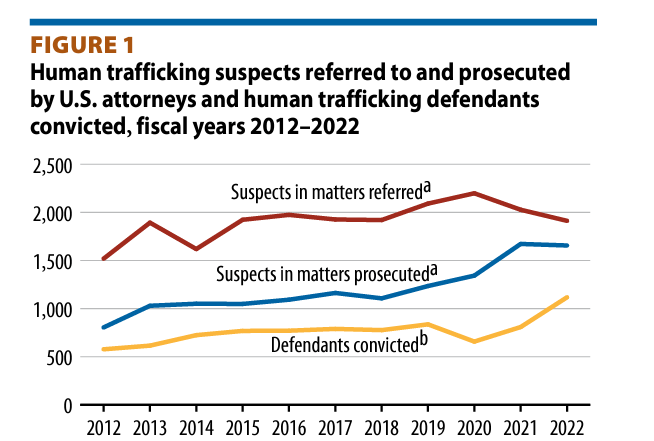
Source: U.S. Department of Justice’s Office of Justice Statistics
According to the U.S. Department of Justice’s Bureau of Justice Statistics, the number of persons prosecuted for human trafficking more than doubled from 2012 to 2022 from 805 to 1,656 persons. The number of persons convicted of a human trafficking offense increased from 578 persons in 2012 to 1,118 persons in 2022.
Of the 1,070 defendants charged with any of the three types of human trafficking offenses in U.S. district court in fiscal year 2022:
- 91% were male
- 58% were White
- 20% were Black
- 18% were Hispanic
- 95% were U.S. citizens
- 71% had no prior convictions.
Human Trafficking on College Campuses
Although exact numbers are unknown since they are vastly underreported, there have been confirmed cases of human trafficking on U.S. college and university campuses.
Read the full article here, watch the interview here, or listen on Spotify or Apple.
 Amy Rock Editorial, LLC